
Step 1: Choosing the Right Entity Type (WOS vs. LLP vs. Branch Office)
The choice of entity type is the foundational decision in your India market entry, and it has downstream consequences for tax treatment, liability exposure, regulatory compliance burden, and exit flexibility. The three most common structures for foreign companies are a Wholly Owned Subsidiary (WOS) incorporated as a private limited company, a Limited Liability Partnership (LLP), and a Branch Office or Liaison Office. Each carries distinct advantages and limitations under the Companies Act 2013, the Limited Liability Partnership Act 2008, and FEMA regulations respectively. The right choice depends on your business model, revenue expectations, and long-term India strategy.
- A private limited company (WOS) is the most versatile structure, offering limited liability, ability to raise equity and debt, full repatriation of profits as dividends, and eligibility for government incentives under schemes like PLI (Production Linked Incentive)
- An LLP offers pass-through taxation and lower compliance burden (no mandatory audit below INR 40 lakh turnover or INR 25 lakh capital), but 100% FDI in LLPs is permitted only in sectors where 100% FDI is allowed under the automatic route with no FDI-linked performance conditions
- A Branch Office can undertake specific activities (export/import, consultancy, R&D, technical support) but cannot carry out manufacturing or retail trading, and its profits are taxable in India at 40% plus surcharge and cess
- A Liaison Office is limited to representational activities (market research, communication) and cannot earn revenue in India, making it suitable only as a short-term exploratory presence with a typical RBI approval validity of 3 years
- Project Offices are permitted for foreign companies executing specific contracts in India and are automatically approved by the AD bank, provided the project is funded by inward remittance or a bilateral/multilateral financing arrangement
If your India revenue is expected to exceed USD 1 million within 3 years, start with a private limited company (WOS). The incremental compliance cost over an LLP is approximately INR 2-3 lakh per year, but the WOS gives you the structural flexibility to raise capital, issue ESOPs, and eventually list on Indian exchanges, none of which an LLP can do.
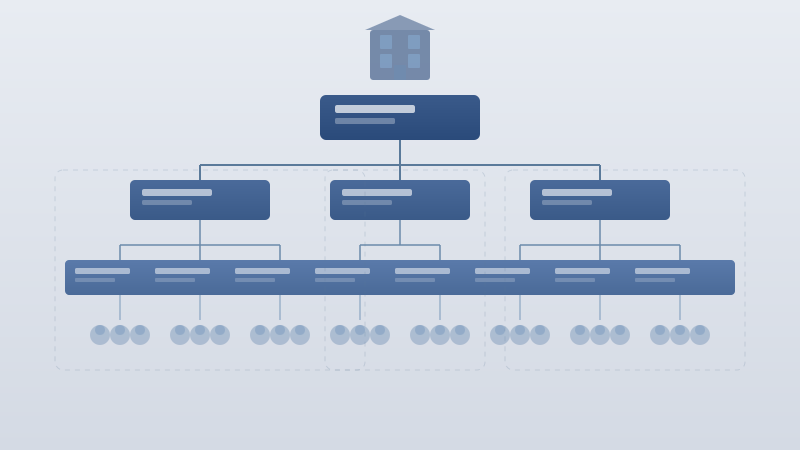
Choosing the right subsidiary structure in India determines your tax efficiency, liability exposure, and operational flexibility.
Step 2: The MCA Incorporation Process, Demystified
Incorporating a company in India is administered by the Ministry of Corporate Affairs (MCA) through its online portal, MCA21 (Version 3, launched 2023). The process has been streamlined through the SPICe+ (Simplified Proforma for Incorporating Company Electronically Plus) form, which integrates company name reservation, incorporation, DIN allotment, PAN/TAN issuance, GST registration, EPFO/ESIC registration, and bank account opening into a single application. Despite the digitisation, the process requires careful preparation of documents, particularly for foreign shareholders and directors, where apostilled or notarised documents from the home country are mandatory.
- Obtain Digital Signature Certificates (DSC) for all proposed directors. Foreign directors must obtain a DSC from a licensed Indian Certifying Authority, which requires submission of passport, address proof, and a video verification KYC
- File SPICe+ Part A for name reservation (up to 2 name options), with names checked against the MCA's existing database and the Trade Marks Registry. Expect approval or rejection within 2-3 business days
- File SPICe+ Part B with the Memorandum of Association (MoA), Articles of Association (AoA), declarations by directors (Form INC-9), and consent to act as director (Form DIR-2). Foreign subscribers must provide apostilled documents under the Hague Convention
- Minimum capital requirement has been abolished for private limited companies, but a practical minimum of INR 1 lakh is advisable for bank account opening and initial operations. The authorised capital determines the stamp duty payable, which varies by state (Maharashtra: 0.15%, Karnataka: 0.3%, Delhi: 0.1%)
- Upon successful filing, the Registrar of Companies issues a Certificate of Incorporation with the Company Identification Number (CIN), PAN, and TAN. The entire process takes 7-12 business days if documents are in order
India has climbed to 63rd on the World Bank's Ease of Doing Business Index (before its discontinuation) and now ranks in the top 25 globally for starting a business. The average incorporation timeline has dropped from 30 days in 2018 to 8 days in 2026, with the SPICe+ integration reducing the number of separate registrations from 7 to 1.
Step 3: RBI Compliance and Capital Account Transactions
Once incorporated, the Indian subsidiary must comply with the Reserve Bank of India's framework for capital account transactions. The initial capitalisation of the subsidiary, whether through equity or a combination of equity and debt, must follow FEMA's Non-Debt Instrument Rules 2019 (for equity) and External Commercial Borrowing (ECB) guidelines (for debt). The capitalisation structure has significant tax implications: thin capitalisation rules under Section 94B of the Income Tax Act 1961 limit interest deductibility on associated enterprise debt to 30% of EBITDA, making it essential to plan the debt-equity mix carefully.
- Equity infusion must be reported on the RBI's FIRMS portal within 30 days of allotment of shares, accompanied by a KYC certificate from the foreign investor, FIRC from the AD bank, and a valuation certificate for shares issued at a premium
- The pricing of shares issued to a non-resident must be at or above the fair market value determined by a SEBI-registered merchant banker using the DCF method for unlisted companies, as per FEMA's Non-Debt Instrument Rules
- ECB from the parent company is permitted under the automatic route up to USD 750 million per financial year, with a minimum average maturity period of 3 years and an all-in cost ceiling linked to the benchmark rate plus a spread of 450 basis points
- Capitalisation via share warrants or convertible instruments is permissible but must comply with pricing norms at the time of issuance, and the conversion must occur within 18 months (or such period as specified by RBI)
- Maintain a clear paper trail of the source of funds, the remittance path, and the purpose code used for each inward remittance. RBI audits increasingly focus on purpose code accuracy, and misclassification can result in the AD bank blocking future transactions
Do not commingle operational advances from the parent company with equity capitalisation. Amounts received by the Indian subsidiary as advances for goods or services must be settled within the prescribed timeline, or they risk being classified as unregistered ECB. An unregistered ECB attracts compounding penalties of up to 3x the amount involved.

India's incorporation process requires precise documentation across MCA, RBI, and sector-specific regulatory bodies.

India Subsidiary Setup: Step-by-Step Guide
The definitive 2026 checklist for incorporating, capitalising, banking, and maintaining a fully compliant Indian subsidiary, from entity selection through ongoing statutory obligations.
Step 4: Opening a Bank Account (Harder Than It Should Be)
Opening a bank account for a foreign-owned Indian subsidiary remains one of the most operationally frustrating steps in the incorporation process, despite regulatory efforts to simplify it. Banks conduct enhanced due diligence on companies with foreign beneficial ownership, driven by RBI's KYC Master Direction 2016 (updated 2025) and the Prevention of Money Laundering Act 2002. The practical reality is that each bank has its own interpretation of documentary requirements, and the process can take anywhere from 2 weeks to 8 weeks depending on the bank, the branch, and the completeness of your documentation.
- Open the account before the first capital infusion, as the subsidiary needs an active current account to receive inward remittance. SPICe+ Part B now includes an integrated bank account opening request with select banks (SBI, PNB, Bank of Baroda, HDFC Bank, ICICI Bank, Axis Bank)
- Required documents typically include: Certificate of Incorporation, MoA and AoA, board resolution authorising account opening, PAN card of the company, KYC documents of all directors and authorised signatories (passport, address proof, photographs), and the parent company's certificate of incorporation and financial statements
- Foreign directors who are not physically present in India can complete video KYC (V-KYC) under the RBI's 2020 V-KYC guidelines, but not all banks offer this facility. Confirm V-KYC availability before selecting a bank
- Open accounts with at least two banks from the outset: one for operational transactions and one for salary disbursement, as this simplifies compliance with TDS (Tax Deducted at Source) deposits and provides operational redundancy
- Apply for a Foreign Inward Remittance Certificate (FIRC) facility with the bank immediately, as you will need FIRCs for every FDI-related inward remittance to file the mandatory reporting on FIRMS
Choose a bank with a dedicated foreign company desk or NRI/FDI cell. The large private banks (HDFC, ICICI, Axis, Kotak) and select foreign banks (HSBC, Standard Chartered, Deutsche Bank) have specialised teams that understand FEMA compliance requirements. A generalist branch relationship manager will add weeks to your timeline and increase the risk of documentation round-trips.


India's diverse business landscape offers unique opportunities for subsidiaries across technology, manufacturing, and services.
Step 5: Ongoing Compliance, the Perpetual To-Do List
Incorporation is the beginning, not the end, of your compliance journey in India. An Indian subsidiary faces a multi-layered compliance framework spanning corporate law (Companies Act 2013), tax law (Income Tax Act 1961, GST Acts), labour law (Code on Wages 2019, Code on Social Security 2020), and sector-specific regulations. The cost of non-compliance is not theoretical: the MCA conducts regular automated compliance checks through its CODS (Company Offence Detection System), and directors of defaulting companies can be disqualified under Section 164(2) of the Companies Act. Building a compliance calendar from day one is non-negotiable.
- File annual financial statements (Form AOC-4) within 30 days of the AGM and the annual return (Form MGT-7) within 60 days of the AGM with the Registrar of Companies. The AGM must be held within 6 months of the financial year end (September 30 for a March year-end)
- Statutory audit is mandatory for all private limited companies regardless of turnover. Appoint a chartered accountant firm as statutory auditor at the first AGM for a term of 5 years (individual) or 10 years (firm), with mandatory auditor rotation thereafter
- GST compliance requires monthly filing of GSTR-1 (outward supplies by the 11th), GSTR-3B (summary return by the 20th), and annual GSTR-9 by December 31. Input tax credit reconciliation under GSTR-2B is now auto-populated but must be verified monthly
- Transfer pricing documentation (including a Local File, Master File, and Country-by-Country Report if the parent's consolidated revenue exceeds EUR 750 million) must be maintained contemporaneously and filed with the Income Tax return by November 30
- Labour law compliance under the new Codes (effective in phases from 2025-26) includes PF contributions at 12% of basic wages (employer and employee each), ESI contributions for employees earning up to INR 21,000 per month, and professional tax registration in states that levy it
The average Indian subsidiary faces 67 separate compliance filings per year across MCA, Income Tax, GST, PF, ESI, and state-level authorities. Non-compliance with even routine filings (such as the annual return) can result in director disqualification, which bars the individual from being appointed as a director in any Indian company for 5 years. Invest in a compliance management tool or outsource to a firm that provides a digital compliance tracker.

India Subsidiary Setup: Step-by-Step Guide
The definitive 2026 checklist for incorporating, capitalising, banking, and maintaining a fully compliant Indian subsidiary, from entity selection through ongoing statutory obligations.