

Entity Comparison: Private Limited vs LLP vs Branch vs Liaison Office
The first and most consequential decision for any foreign company entering India is entity selection. India offers four primary vehicles for foreign participation, each with radically different regulatory, tax, and operational profiles. A Private Limited Company (under the Companies Act, 2013) is the most common choice — it offers limited liability, is eligible for FDI under the automatic route in most sectors, and provides the cleanest path to profit repatriation via dividends. A Limited Liability Partnership (LLP), governed by the LLP Act, 2008, offers operational flexibility and lower compliance burden, but FDI is permitted only in sectors where 100% FDI is allowed under the automatic route and where there are no FDI-linked performance conditions. Branch Offices and Liaison Offices, approved by the RBI under FEMA regulations, serve narrower purposes — branches can undertake revenue-generating activities (export/import, consultancy, technical support), while liaison offices are restricted to communication and representational roles with no income-generating activity permitted on Indian soil. The choice is never purely legal; it is fundamentally a tax and commercial decision.
- Private Limited Companies face an effective tax rate of 25.17% (base rate 22% plus surcharge and cess under Section 115BAA) and can repatriate profits freely as dividends after paying applicable dividend distribution obligations
- LLPs are taxed at a flat 30% (plus surcharge and cess) with no Dividend Distribution Tax, but partner remuneration and interest deductions are capped under Section 40(b) of the Income Tax Act
- Branch Offices are taxed at 40% on Indian-attributable income (plus surcharge and cess), making them the most tax-inefficient vehicle for long-term operations
- Liaison Offices cannot earn any income in India and must be funded entirely by inward remittances — the RBI reviews and renews permissions every 3 years with increasingly strict scrutiny
- FDI into LLPs requires prior government approval if the sector has any conditions (such as minimum capitalisation or lock-in periods), and downstream investment from LLPs into Indian companies is not permitted under FEMA
Many foreign companies default to a Liaison Office for initial market exploration. Be aware that the RBI has significantly tightened renewal scrutiny since 2023. If a liaison office fails to demonstrate genuine preparatory activity or is found to be generating revenue directly or indirectly, the RBI can order closure with a 60-day wind-down period.
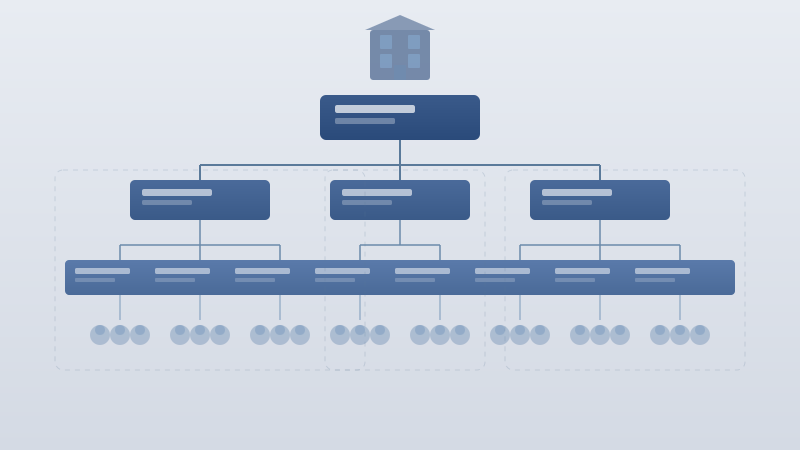
Corporate structuring in India involves choosing between subsidiaries, branches, LLPs, and joint ventures based on liability, tax, and operational considerations.
Holding Company Structures: Layering for Control, Tax, and Exit
Once the base entity is established, the question of vertical structuring arises — should operations run directly through the Indian subsidiary, or should an intermediate holding company (HoldCo) be introduced? The answer depends on three variables: the number of Indian operating entities planned, the anticipated exit strategy, and the tax treaty network. A Mauritius or Singapore intermediate HoldCo was historically the default for tax-efficient capital gains treatment, but post the 2017 Multilateral Instrument (MLI) ratification and the introduction of the Principal Purpose Test (PPT), substance requirements have rendered shell-company structures ineffective. The current best practice involves establishing genuine intermediate holding entities — with local boards, employees, decision-making authority, and real economic activity — in treaty jurisdictions. Within India, Section 2(87) of the Companies Act defines subsidiary and holding company relationships based on board composition control or share capital holding exceeding 50%. Multi-tier structures (parent > Indian HoldCo > operating subsidiaries) offer flexibility for sectoral segregation, ring-fencing of liabilities, and staged divestiture, but they also attract the Registrar of Companies' scrutiny under the 2-layer investment restriction introduced by the Companies (Amendment) Act, 2019.
- The 2-layer investment company restriction under Section 2(87A) prevents Indian companies from having more than two layers of investment companies between the holding entity and the final operating subsidiary, with exceptions for banking, insurance, and NBFC sectors
- Singapore-India DTAA provides for 0% capital gains tax on share transfers if the seller held less than 25% of the Indian company at any time during the 12 months before transfer — critical for PE/VC exits
- Mauritius-India treaty was amended effective April 2017, subjecting capital gains on shares acquired after that date to Indian tax, with a grandfathering provision for pre-April 2017 investments
- Indian HoldCo structures enable tax-efficient cash pooling across subsidiaries through inter-corporate deposits (ICDs) under Section 186 of the Companies Act, subject to a cap of 60% of paid-up share capital plus free reserves
- The Principal Purpose Test (PPT) under the MLI requires demonstrating that obtaining treaty benefits was not one of the principal purposes of the arrangement — failure triggers denial of treaty relief
If you plan to operate in multiple Indian sectors (say, manufacturing and fintech), establish separate operating subsidiaries under a single Indian HoldCo. This allows sector-specific regulatory compliance, independent financing, and clean carve-out options for future partial divestiture — without triggering the 2-layer investment restriction.
Transfer Pricing Considerations: Getting Intercompany Transactions Right
Transfer pricing is arguably the highest-risk area of ongoing compliance for any multinational operating in India. The Indian transfer pricing regime, codified under Sections 92 to 92F of the Income Tax Act, is among the most aggressively enforced globally. The Transfer Pricing Officer (TPO) has the authority to adjust intercompany transaction values to arm's length, and Indian adjustments have historically been among the largest worldwide — both in absolute quantum and as a percentage of assessed income. India follows the OECD Transfer Pricing Guidelines as a reference but applies them with notable local departures. The most significant is the use of the "range concept" — where the arm's length price is determined as the interquartile range (35th to 65th percentile) of comparable transactions, rather than the full range. If the taxpayer's transaction price falls outside this range, the adjustment is made to the median. The documentation requirements are three-tiered under the BEPS Action 13 framework: Local File (mandatory for all international transactions exceeding INR 1 crore), Master File (mandatory if aggregate international transactions exceed INR 50 crore), and Country-by-Country Report (CbCR, mandatory for groups with consolidated revenue exceeding INR 5,500 crore).
- The arm's length range in India is narrowed to the 35th-65th percentile interquartile range — transactions priced outside this range face adjustment to the median, not merely to the nearest edge of the range
- Advance Pricing Agreements (APAs) — both unilateral and bilateral — have seen significant uptake, with over 600 APAs signed since the programme's inception in 2012, providing certainty for 5 years (extendable by 4 years through rollback)
- Safe Harbour Rules under Section 92CB prescribe minimum margins for specified categories — IT/ITeS (17-18% operating margin), KPO (24%), contract R&D (24%), and auto component manufacturing (12%) — providing a compliance shortcut
- Specified Domestic Transactions (SDTs) above INR 20 crore threshold are also subject to transfer pricing provisions, catching related-party payments between Indian group entities — a provision unique to India
- Penalty for transfer pricing non-compliance is 2% of the value of the international transaction for failure to maintain documentation, and 50% of tax on adjusted income for under-reporting (reduced from 200% under the pre-2016 regime)
India's CBDT processed over 3,800 transfer pricing assessments in FY2025, resulting in aggregate adjustments exceeding INR 92,000 crore. The IT/ITeS sector accounted for approximately 38% of all adjustments by value.

Legal structuring decisions made at incorporation stage have lasting implications for transfer pricing, dividend repatriation, and exit flexibility.
India Corporate Structure Decision Guide
A decision-oriented guide for foreign companies entering India — covering entity selection, holding structures, transfer pricing compliance, thin capitalisation rules, and restructuring mechanisms under Indian corporate and tax law.
Thin Capitalisation Rules: Section 94B and Its Operational Impact
India's thin capitalisation rule, introduced via Section 94B of the Income Tax Act (effective from April 2018), caps the deductibility of interest paid to associated enterprises (AEs) at 30% of EBITDA. This provision, aligned with BEPS Action 4 recommendations, applies to Indian entities paying interest — whether on loans, debentures, or any form of debt — to non-resident AEs, where the aggregate interest exceeds INR 1 crore in a financial year. The disallowed interest can be carried forward for up to 8 assessment years, providing partial relief for capital-intensive businesses with lumpy investment cycles. The rule interacts critically with the overall debt-equity structuring of Indian subsidiaries. Prior to Section 94B, the only effective cap on interest deduction was the arm's length test under transfer pricing — but the thin capitalisation rule now imposes an absolute ceiling regardless of whether the interest rate itself passes the arm's length test. For leveraged acquisitions and infrastructure projects funded predominantly by shareholder debt, this provision can materially alter after-tax returns.
- Section 94B caps interest deductibility on AE debt at 30% of EBITDA, with EBITDA computed as per book profits before interest, tax, depreciation, and amortization — not taxable income
- The INR 1 crore threshold is an aggregate trigger — once total AE interest exceeds this amount, the 30% EBITDA cap applies to the entire AE interest amount, not just the excess
- Disallowed interest under Section 94B can be carried forward for 8 years and set off against income in subsequent years, subject to the 30% EBITDA cap in the carry-forward year
- Banking and insurance companies are explicitly excluded from Section 94B, reflecting their inherently leveraged business models and separate regulatory capital frameworks
- The provision applies to all forms of debt — loans, debentures, deposits, and any other borrowing arrangement — not limited to traditional term loans, catching hybrid instruments that are classified as debt
Section 94B applies independently of transfer pricing. Even if your intercompany interest rate passes the arm's length test under Section 92, the total quantum of interest deduction can still be disallowed under the 30% EBITDA cap. Model both constraints simultaneously when designing your India capital structure.


Tax-efficient structuring can reduce effective tax rates by 8-15% through careful use of DTAA provisions, SEZ benefits, and holding company arrangements.
Restructuring Options: Mergers, Demergers, and Slump Sales Under Indian Law
Indian corporate restructuring operates under a dual framework — the Companies Act, 2013 (specifically Sections 230 to 240, governing schemes of arrangement) and the Income Tax Act (Sections 2(1B), 2(19AA), and 47 for tax-neutral treatment). The National Company Law Tribunal (NCLT) exercises jurisdiction over all schemes of arrangement, including mergers, demergers, and compromises with creditors. A tax-neutral merger under Section 2(1B) requires that all assets and liabilities of the transferor company vest in the transferee, shareholders of the transferor receive shares in the transferee (not cash), and the transferee holds at least 75% of the shares in the transferor. Demergers under Section 2(19AA) enable tax-neutral vertical splits — the resulting company assumes the demerged undertaking along with its assets, liabilities, and employees, and shareholders of the demerging company receive shares in the resulting company proportionally. Slump sales (Section 50B) offer a simpler alternative for divesting a business undertaking as a going concern, taxed at applicable capital gains rates on the difference between sale consideration and net worth of the undertaking. The 2021 amendment introduced slump exchange as a distinct concept, bringing non-cash consideration transactions within the tax net.
- NCLT-approved schemes of arrangement (mergers/demergers) typically take 8 to 14 months from filing to final order, with mandatory creditor and shareholder meetings requiring 75% approval by value
- Tax-neutral merger status under Section 2(1B) requires the transferee to issue shares to transferor shareholders — any cash component beyond a de minimis threshold triggers taxability on the entire transaction
- Cross-border mergers are permitted under Section 234 of the Companies Act and Rule 25A of the Companies (Compromises, Arrangements and Amalgamations) Rules, 2016, subject to RBI approval and prior NCLT sanction
- Slump sale taxation under Section 50B applies long-term capital gains rates (12.5% under the amended Finance Act 2024 provisions) if the undertaking was held for more than 36 months, with net worth computed without revaluation of assets
- Fast-track mergers under Section 233 (for small companies or parent-subsidiary combinations with 90% or more shareholding) bypass NCLT and require only Regional Director approval, reducing timelines to 3-4 months
For group restructuring involving multiple entities, consider filing interconnected NCLT schemes simultaneously rather than sequentially. NCLT benches have shown willingness to hear linked schemes together, reducing the overall timeline from 24-30 months (sequential) to 10-14 months (parallel) for multi-entity reorganizations.

India Corporate Structure Decision Guide
A decision-oriented guide for foreign companies entering India — covering entity selection, holding structures, transfer pricing compliance, thin capitalisation rules, and restructuring mechanisms under Indian corporate and tax law.