
The Indian Distributor Landscape: Fragmented by Design
India's distribution infrastructure is among the most fragmented in the world, and that fragmentation is a feature, not a bug. The country's retail universe encompasses approximately 12 to 14 million kirana stores, 9,500-plus modern trade outlets, and a rapidly growing universe of digital-native channels. No single distributor covers the country end-to-end. Instead, the system operates through layered hierarchies: national distributors who hold master inventory, regional carrying-and-forwarding agents (CFAs) who manage state-level logistics, city-level distributors who service retail clusters, and sub-distributors or salesmen who handle last-mile delivery to individual shops. Understanding this hierarchy and placing your product at the right level is the foundational decision of any India channel strategy. The FMCG sector, which has spent decades perfecting Indian distribution, typically operates with a 4-tier structure that achieves coverage of 6 to 8 million outlets for the largest players like Hindustan Unilever and ITC.
- India has 12-14 million kirana (neighbourhood) stores, roughly 9,500 modern trade outlets, and over 200,000 active e-commerce sellers — no single entity covers this footprint alone
- The standard distribution hierarchy is four layers deep: national distributor, regional CFA, city distributor, and sub-distributor or beat salesman handling last-mile store visits
- Hindustan Unilever reaches roughly 8 million outlets through 3,500-plus distributors — replicating even a fraction of this reach requires years of systematic territory buildout
- Distributor exclusivity norms vary by category: FMCG distributors typically carry competing brands, while consumer electronics and automotive distributors often operate under exclusivity agreements
- Cold chain distribution for perishables remains a critical bottleneck — India loses an estimated INR 92,000 crore annually in post-harvest food waste due to cold chain gaps, per the National Centre for Cold Chain Development
India's organised logistics market is projected to reach USD 380 billion by 2027, but cold chain penetration remains below 4 percent of total perishable produce, creating both risk and opportunity for new entrants.

India's distribution landscape spans 12 million retail outlets, requiring a multi-tier channel strategy to achieve meaningful market coverage.
Selecting the Right Channel Partners: A Scoring Framework
Choosing the wrong distributor in India does not just slow you down — it can lock you out of a territory for years. Distributor agreements in India, even informal ones, create de facto territorial rights that are difficult and expensive to unwind. The selection process must be rigorous, multi-dimensional, and grounded in on-the-ground verification rather than capability decks. At BankersKlub, we evaluate potential channel partners across seven dimensions: financial health (audited balance sheets and credit reports from CIBIL or CRIF), territory coverage (number of outlets actively serviced, verified through beat plans), category expertise (experience with similar product types and price points), warehousing infrastructure (owned vs. leased, temperature control capability, FSSAI licensing for food), salesforce strength (number of dedicated salespeople and their route productivity), retailer relationships (depth and tenure of relationships with key accounts in the territory), and technology readiness (ability to integrate with your DMS or order management platform). A weighted scoring model across these dimensions prevents the common trap of selecting partners based on a single impressive metric — usually claimed coverage — while ignoring critical gaps in execution capability.
- Always verify claimed coverage independently — request the distributor's actual beat plan (daily route and outlet visit schedule) and cross-check a random sample of listed outlets through field visits
- Financial due diligence is non-negotiable: obtain at least two years of audited financials and a CIBIL commercial credit report before signing any distribution agreement
- Prioritise distributors with existing salesforce on payroll over those who rely entirely on sub-distributors — direct salesforce gives you better control over in-store execution and merchandising
- Assess technology readiness early: distributors who cannot integrate with a cloud-based DMS (Distributor Management System) like Bizom, FieldAssist, or Botree will create data blind spots that hamper demand planning
- Structure the initial agreement as a 12-month probationary period with clearly defined KPIs (minimum order value, outlet coverage targets, payment cycle adherence) and a documented exit clause
Before finalising a distributor, spend two days riding along with their sales team on their daily beat. You will learn more about their actual execution capability in 48 hours than in any number of conference room presentations.
Territory Design: Mapping India's Micro-Markets
Effective territory design in India requires a granularity that surprises most foreign entrants. A single city like Mumbai contains micro-markets with wildly different purchasing behaviour: South Mumbai's affluent consumers, the aspirational middle class of the western suburbs, the price-sensitive but high-volume markets of Navi Mumbai, and the industrial-commercial corridor of Thane. Treating Mumbai as one territory is a guaranteed path to either over-investment in saturated pockets or under-coverage of high-potential zones. Best-in-class territory mapping uses a combination of Census 2021 ward-level population data, NSSO consumption expenditure data, and proprietary retail audit data (from firms like Nielsen or Kantar) to define territories based on economic homogeneity rather than administrative boundaries. Each territory should be sized to support one distributor at a minimum viable scale — typically INR 15 to 25 lakh in monthly secondary sales for FMCG, higher for durables. The objective is to create territories large enough to sustain a profitable distributor but small enough to ensure intensive coverage.
- Define territories by economic clusters, not administrative boundaries — a PIN code-level or ward-level approach yields far better resource allocation than city-level or district-level mapping
- Size each territory to sustain a minimum viable distributor business: INR 15-25 lakh monthly secondary sales for FMCG, INR 40-60 lakh for consumer electronics, adjusted for local market economics
- Use Census 2021 ward-level data overlaid with NSSO consumption expenditure surveys to identify high-potential micro-markets that national competitors may be underserving
- Map competitive intensity by territory before finalising your entry sequence — territories with low competitive saturation and high disposable income should be prioritised for Phase 1 launch
- Build territory-level P&L models that account for local logistics costs, distributor margins, and retailer credit norms — these vary significantly across states due to differences in road infrastructure, fuel costs, and trade practices
India's top 50 cities account for only 31 percent of national consumption expenditure. The remaining 69 percent is distributed across 7,900-plus cities and 640,000 villages — territory strategy must account for this long-tail reality.
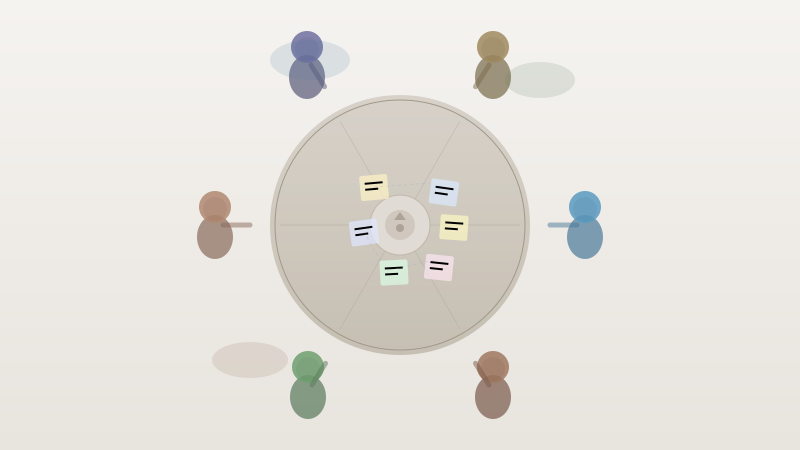
Effective channel partner management combines regular performance reviews, co-marketing investments, and transparent margin structures.
India Distribution & Channel Strategy Guide
The operational playbook for building, managing, and scaling sales channels in India — from distributor selection and territory design to incentive engineering and digital-traditional channel integration.
Incentive Engineering: Aligning Distributor and Brand Interests
The single most common reason for channel failure in India is misaligned incentives. Distributors in India operate on thin margins — typically 3 to 8 percent for FMCG, 6 to 12 percent for consumer durables — and supplement these with volume rebates, cash discounts for prompt payment, and scheme-based incentives tied to quarterly targets. If your margin structure does not allow a distributor to earn a competitive return on the working capital they deploy, they will quietly deprioritise your brand in favour of products that do. Incentive design must account for the full spectrum of distributor economics: basic trade margin, volume-linked slabs, prompt payment discounts (typically 1 to 2 percent for payment within 7 days), new outlet activation bonuses, and seasonal push incentives tied to festival periods. The best programmes also include non-monetary incentives — annual dealer conferences (a deeply embedded tradition in Indian trade culture), recognition awards, and foreign travel incentives for top performers. Under GST, all trade schemes and discounts must be structured carefully to avoid creating deemed supply events or reversals of input tax credit under Section 15 of the CGST Act.
- Baseline distributor margins of 3-8 percent (FMCG) or 6-12 percent (durables) are table stakes — the real competitive advantage comes from well-designed volume slabs and prompt payment incentives
- Structure quarterly volume targets with 3 progressive slabs: achievable (80 percent of target earns base rebate), stretch (100 percent earns enhanced rebate), and aspirational (120 percent earns top-tier rebate plus non-monetary rewards)
- Prompt payment discounts of 1-2 percent for settlement within 7 days dramatically improve your working capital cycle and reduce bad debt exposure — make this a standard programme element
- New outlet activation bonuses (INR 200-500 per new outlet billed in a quarter) incentivise numeric distribution expansion without requiring you to fund the distributor's salesforce directly
- All trade schemes must be documented and structured to comply with GST Section 15 valuation provisions — poorly structured discounts can trigger ITC reversals and create tax exposure for both the brand and the distributor
Post-sale discounts and incentives that are not linked to the original tax invoice may be treated as separate supplies under GST, triggering additional tax liability. Structure all channel incentives with GST counsel before announcement.
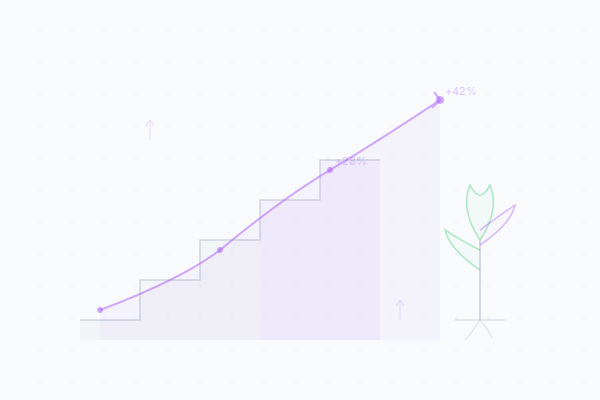
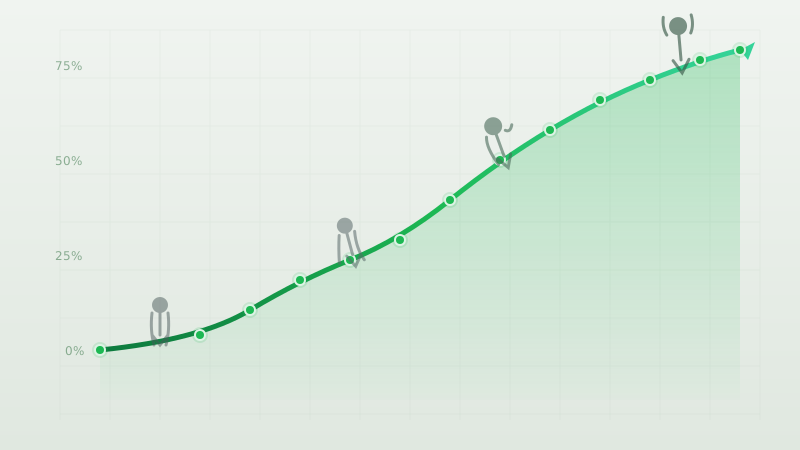
Companies that invest in omnichannel distribution in India see 35-50% faster revenue growth compared to single-channel approaches.
Integrating Digital Commerce Without Cannibalising Traditional Trade
The explosive growth of e-commerce and quick commerce in India has created a channel conflict problem that every brand must now actively manage. When a consumer can buy your product on Blinkit at a 15 percent discount with 10-minute delivery, your kirana retailer and traditional distributor — who carry your inventory, extend credit, and provide shelf space — feel undercut and betrayed. The resulting resentment manifests as reduced shelf visibility, delayed payments, and eventually, defection to competing brands. The solution is not to avoid digital channels but to integrate them into a unified channel architecture with clearly differentiated roles. Assign specific SKUs or pack sizes exclusively to online channels (the 'e-commerce pack' strategy that Hindustan Unilever and Marico have deployed effectively). Maintain price parity across channels for core SKUs by enforcing MAP (Minimum Advertised Price) policies in distributor agreements. Use direct-to-consumer channels for new product launches and limited editions, then migrate successful products into general trade once demand is proven. ONDC (Open Network for Digital Commerce), the Indian government's interoperable e-commerce protocol, is an emerging channel that could reshape digital distribution by reducing platform dependency — brands should begin pilot integrations now.
- Deploy channel-exclusive SKUs or pack sizes to prevent direct price comparison — a 180ml e-commerce-exclusive variant does not cannibalise the 200ml general trade pack even if the per-unit price differs
- Enforce MAP (Minimum Advertised Price) clauses in all distributor and marketplace agreements for core SKUs to maintain price parity and protect traditional trade relationships
- Use D2C and marketplace channels for new product seeding and demand testing, then roll proven products into general trade with the confidence of validated demand data
- Begin pilot integration with ONDC (Open Network for Digital Commerce), the government-backed interoperable protocol that allows brands to sell across multiple buyer apps without exclusive platform dependency
- Implement unified order management across channels to prevent inventory fragmentation — brands using separate inventory pools for online and offline channels typically carry 25-30 percent excess safety stock
Create a dedicated 'e-commerce task force' within your India team that includes representation from traditional trade, digital commerce, and supply chain. Channel conflict festers when these functions operate in silos — a shared P&L and joint planning cadence is the antidote.

India Distribution & Channel Strategy Guide
The operational playbook for building, managing, and scaling sales channels in India — from distributor selection and territory design to incentive engineering and digital-traditional channel integration.