
Primary vs. Secondary Research in India: Choosing the Right Intelligence Mix
Market research in India demands a dual approach that most foreign entrants underweight on the primary side. Secondary data from government sources — the Annual Survey of Industries, NSSO consumption expenditure surveys, RBI's Handbook of Statistics, and DPIIT's FDI factsheets — provides macro context but rarely captures the granularity needed for a go/no-go decision. The gap between published data and ground truth in India is wider than in mature markets. Census data is decennial, consumption surveys have multi-year lags, and private databases like CMIE's Consumer Pyramids or Euromonitor cover urban India far better than Tier 3 and rural segments. This is why primary research — structured interviews, focus groups, retail audits, and on-ground surveys — is not optional in India. It is the only reliable way to validate secondary hypotheses about pricing sensitivity, channel preferences, brand awareness, and purchase triggers in the specific geography and customer segment you intend to serve.
- The Ministry of Statistics and Programme Implementation (MoSPI) publishes the Annual Survey of Industries and the Periodic Labour Force Survey — both are freely available and provide district-level economic and employment data essential for workforce and demand planning
- CMIE's Consumer Pyramids database covers over 170,000 households across India with quarterly panels tracking income, expenditure, assets, and consumer sentiment — it is the most granular commercially available dataset for understanding Indian consumption patterns
- Primary research in India must account for respondent bias: urban Indian consumers tend to overstate purchase intent by 30-40% in survey settings, making revealed-preference methods (retail audits, transaction data analysis) a necessary validation layer
- Regional language capability is non-negotiable for primary research — India has 22 constitutionally recognized languages, and research instruments must be translated and culturally adapted, not merely translated, to yield reliable data
- Government data portals including data.gov.in, the India Trade Portal, and the DGCIS trade statistics database provide free access to import-export data, production statistics, and economic indicators that form the backbone of secondary market sizing
Commission primary research in two phases. Phase 1: qualitative (20-30 depth interviews with channel partners, distributors, and end-users) to generate hypotheses. Phase 2: quantitative (structured survey of 500+ respondents across target geographies) to validate. This two-phase approach typically costs 40% less than running a single large quantitative study that asks the wrong questions.

Rigorous market research methodology tailored to India accounts for regional diversity, informal economy dynamics, and rapidly shifting consumer demographics.
Consumer Behavior Variations: Urban, Rural, and Digital India Are Three Different Markets
The single most consequential error in India market research is treating the country as one market. It is, at minimum, three — urban India (about 35% of the population concentrated in cities with 1 lakh+ population), rural India (65% of the population in villages and small towns), and digital India (over 800 million internet users, but with sharply varying digital sophistication). These three segments differ not just in income but in decision-making structures, brand relationships, channel preferences, and price sensitivity. Urban India's consumer behavior increasingly resembles Southeast Asian markets, with digital-first discovery, comparison shopping, and brand promiscuity. Rural India operates on trust networks — the local retailer's recommendation carries more weight than a digital advertisement, and purchase decisions often involve extended family consultation. Digital India cuts across both, but its composition skews young and male, and digital payment adoption varies dramatically: UPI penetration exceeds 80% in urban markets but drops below 30% in rural areas despite Jio's connectivity revolution.
- Urban India's top 50 cities account for approximately 60% of organized retail consumption but only 15% of India's population — the concentration means that urban-only strategies access the largest wallet share per capita but cap total addressable market at a fraction of the opportunity
- Rural India's consumption patterns are heavily influenced by agricultural income cycles — kharif harvest (October-November) and rabi harvest (March-April) create seasonal demand peaks that are 2-3x baseline purchasing rates for durables and discretionary goods
- India's UPI (Unified Payments Interface) processed over 16 billion transactions monthly by late 2025, but merchant acceptance remains concentrated in urban and semi-urban areas — cash continues to dominate 60-65% of rural retail transactions
- Brand loyalty in India follows a distinctive pattern: consumers display high loyalty in categories involving personal trust (baby care, pharmaceuticals, cooking oil) but low loyalty in aspirational categories (smartphones, fashion, personal care) where they actively seek novelty and social currency
- The 'Bharat vs. India' segmentation framework — distinguishing aspiration-driven urban consumers from value-driven non-metro consumers — is the most commonly used lens for India market strategy, but increasingly requires a third axis for the digital-native segment that transcends geographic boundaries
India's rural FMCG market grew at 9.2% CAGR between 2021 and 2025, outpacing urban FMCG growth of 6.8% over the same period. Rural India now accounts for 38% of total FMCG revenues, up from 33% in 2019, driven by increased connectivity, direct-to-village distribution, and rising agricultural incomes.
Competitive Landscape Mapping: Who You're Really Competing Against
Competitive analysis in India must go beyond the obvious multinational and listed domestic players. The most dangerous competitors for foreign entrants are often unlisted, family-owned businesses with deep regional distribution networks, political relationships, and cost structures that formal-sector companies cannot match. India's competitive landscape is stratified: at the top, large conglomerates (Tata, Reliance, Adani, Birla) compete across sectors with access to capital and regulatory influence. In the middle, a dense layer of mid-size companies with INR 100-5,000 crore revenues dominate specific regions or niches. At the base, informal and semi-formal enterprises control significant market share in categories from building materials to food processing. A comprehensive competitive map must capture all three layers, because your pricing strategy, distribution model, and value proposition will be tested against each of them. The most underestimated dimension is the speed at which Indian competitors respond to foreign entry — within 12-18 months of a successful foreign launch, expect 3-5 domestic clones at 30-50% lower price points.
- The Registrar of Companies database (accessible through the MCA21 portal) provides financial statements, director networks, and charge registers for every Indian registered company — this is your primary source for competitor financial analysis
- Import data from the DGCIS (Directorate General of Commercial Intelligence and Statistics) reveals exactly which products are being imported, by whom, in what quantities, and at what declared values — essential for understanding whether your product category already has a trade-driven competitive presence
- India's trade association landscape is dense and informative: industry bodies like CII, FICCI, NASSCOM, and sector-specific associations publish member directories, industry reports, and policy positions that reveal competitive positioning and lobbying priorities
- The Confederation of Indian Industry's annual manufacturing competitiveness survey and NASSCOM's technology sector reports provide benchmarking data on productivity, cost structures, and technology adoption rates across sectors
- Patent and trademark filings at the Indian Patent Office and Trade Marks Registry (searchable via the IP India portal) reveal competitor R&D direction, brand extension strategies, and technology protection priorities — filing patterns often telegraph market moves 12-18 months ahead
Do not rely solely on English-language sources for competitive intelligence. Many significant regional competitors maintain minimal digital presence and publish financial information only in filings with the ROC. Engage local research partners who can access vernacular trade press, attend regional industry events, and conduct channel checks with distributors to surface competitors invisible to desktop research.
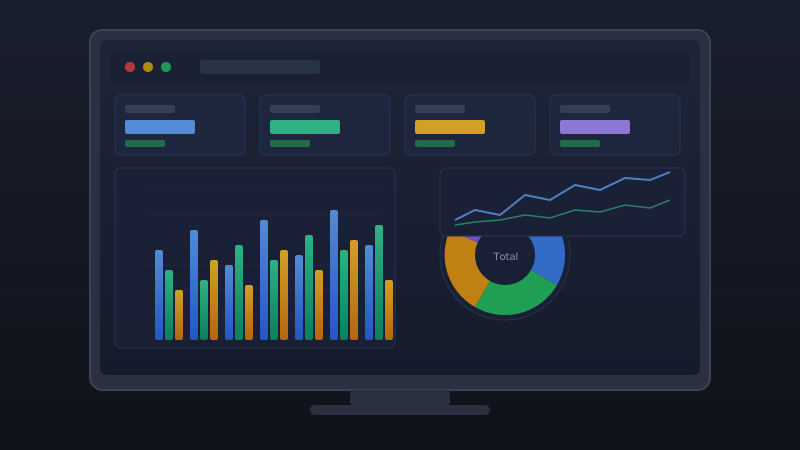
Advanced analytics dashboards synthesize primary research, government data, and proprietary datasets to generate actionable market intelligence.

The India Market Research Toolkit
A practical toolkit for conducting rigorous market research in India — covering data sources, primary research methods, consumer segmentation, competitive mapping, demand estimation, and feasibility study best practices.
Demand Estimation Frameworks: Moving Beyond Top-Down Guesswork
The standard top-down approach to India demand estimation — starting with GDP, deriving addressable population, applying penetration rates, and arriving at a market size — produces numbers that are directionally correct but operationally useless. India's market size figures from global consulting firms routinely overestimate addressable demand by 2-5x because they fail to account for three India-specific factors: the gap between theoretical demand and purchasing power-adjusted demand, the fragmentation of distribution (a product available in 100,000 stores reaches perhaps 15-20% of the population that those stores theoretically serve), and the informal economy's role in serving demand at price points below formal-sector viability. Robust demand estimation for India requires a bottom-up methodology: start from the channel (how many stores, distributors, or digital touchpoints can you realistically activate in years 1-3), layer in per-outlet throughput (based on analogous product performance in similar channels), and adjust for competitive displacement. This bottom-up number should reconcile with, but will always be smaller than, the top-down figure.
- Top-down market sizing using MOSPI's National Accounts Statistics and RBI's KLEMS database provides sector-level GDP contribution and growth rates — useful for macro validation but insufficient for investable demand projections
- Bottom-up estimation must account for India's distribution reality: even in consumer goods, achieving national distribution requires 5-7 years and partnerships with 15-20 super-stockists, 200-500 distributors, and access to over 1 million retail points for mass-market coverage
- The Price Sensitivity Meter (Van Westendorp) and Gabor-Granger methods must be adapted for India — test price points in INR with local purchasing power benchmarks, and always include a 'would purchase from unbranded/local alternative' option to capture informal-sector competition
- Analogous market analysis — examining the adoption curves of similar products or services already in India — provides the most reliable demand trajectory, but must be adjusted for differences in distribution depth, digital penetration, and regulatory environment between the analogy and the target category
- Government procurement data from the Government e-Marketplace (GeM) portal provides actual transaction volumes and prices for thousands of product categories sold to government buyers — this is an underutilized but highly reliable source of revealed demand data for B2G and industrial segments
Always produce three demand scenarios: conservative (achievable with minimal distribution and zero brand awareness), base (achievable with planned distribution and moderate marketing investment), and optimistic (full distribution build-out with strong brand pull). Present the conservative scenario to your board for investment approval — if the unit economics work at conservative volumes, the upside scenarios become genuine upside rather than required performance.

India's market encompasses 1.4 billion consumers across diverse economic tiers, languages, and cultural preferences that defy one-size-fits-all strategies.
Feasibility Study Best Practices: From Research to an Actionable Go/No-Go
A feasibility study for India market entry is not a research report — it is a decision document. The most common failure mode is producing a comprehensive, data-rich study that does not answer the three questions the board actually cares about: Should we enter? If yes, how? And what does it cost if we are wrong? Effective India feasibility studies are structured around a decision tree, not a narrative. Each branch of the tree — entity structure, market segment, go-to-market channel, partnership model — should have clearly defined criteria for proceed, pivot, or abandon. The financial model must incorporate India-specific cost structures: the 18% GST on most goods and services, the 25.17% effective corporate tax rate under the new tax regime (Section 115BAA), customs duties that range from 0% to 150% depending on the tariff line, transfer pricing compliance costs, and the 2-3% annual cost of regulatory compliance that most India business plans omit. A good feasibility study also addresses the exit scenario — not as a concession to pessimism, but as a practical matter: winding up an Indian company takes 2-5 years through the NCLT process, making entry a commitment that outlasts the exit decision by several years.
- Structure the feasibility study around five pillars: market attractiveness (demand, competition, growth trajectory), regulatory feasibility (entry route, approvals, compliance burden), operational feasibility (supply chain, talent, infrastructure), financial feasibility (unit economics, capital requirements, payback period), and risk assessment (political, currency, regulatory, execution)
- Include a detailed regulatory timeline mapping every approval required from Day 0 to commercial launch — for manufacturing operations in India, this timeline typically spans 8-14 months and includes entity incorporation, RBI filings, environmental clearances, factory licenses, and GST registration
- The financial model must use INR as the base currency with explicit exchange rate assumptions and sensitivity analysis — the rupee has depreciated an average of 3-4% annually against the dollar over the past decade, and this trajectory should be reflected in revenue and repatriation projections
- Talent cost modeling should account for India's salary inflation rate of 9-10% annually for skilled professionals, the 12% employer PF contribution, the 4.75% ESI contribution (for eligible employees), and the 15-day-per-year gratuity accrual — total employment cost is typically 25-35% above gross salary
- Exit cost analysis should include an estimate of the time and cost of voluntary liquidation under the Insolvency and Bankruptcy Code, 2016 (minimum 6 months for a solvent company) and the tax implications of repatriating accumulated profits and capital upon closure — including the dividend distribution withholding tax applicable to foreign shareholders
Feasibility studies that conclude with 'India is a large and growing market with significant potential' are worthless. The study must produce a specific, defensible recommendation: enter this segment, through this channel, with this entity structure, at this investment level, with these milestones for proceed/pivot/exit within the first 24 months. Anything less is tourism, not strategy.
The India Market Research Toolkit
A practical toolkit for conducting rigorous market research in India — covering data sources, primary research methods, consumer segmentation, competitive mapping, demand estimation, and feasibility study best practices.