
Central vs State Licenses: Understanding the Jurisdiction Split
India's federal structure divides regulatory authority across the Union List, State List, and Concurrent List under the Seventh Schedule to the Constitution. This division determines whether a license is issued by a central ministry, a state government department, or both. Getting this jurisdictional map wrong is the most common reason foreign companies experience delays. Central registrations like PAN, TAN, GST, IEC (Import Export Code), and company incorporation through MCA are relatively standardized and increasingly digitized. The complexity multiplies at the state and municipal level. Each of India's 28 states and 8 union territories maintains its own regulatory apparatus for shops and establishments, professional tax, local body trade licenses, and state-specific industry regulations. A manufacturing unit in Gujarat faces a fundamentally different approval stack than one in Tamil Nadu, even within the same industry. The introduction of state investment promotion agencies and single-window systems has helped, but these systems vary dramatically in maturity and actual authority.
- Begin with mandatory central registrations: CIN (Company Identification Number) via MCA, PAN and TAN via NSDL/UTIITSL, GST via the GST Portal, and IEC via DGFT before initiating any state-level applications
- Map your state-level requirements by consulting the specific State Industries Department or investment promotion body, as approvals for Shops and Establishments, Professional Tax, and local trade licenses are state-administered with no central standardization
- Identify concurrent jurisdiction areas where both central and state approvals are needed, particularly in labor (factory licensing under the Factories Act is state-administered but centrally legislated) and environmental compliance
- Account for municipal and panchayat-level approvals including building plan sanction, occupancy certificate, signage permits, and fire NOC, which are issued by the local urban development authority or municipal corporation
- Track the implementation status of the new Labor Codes in your specific operating state, as the transition from the old regime (Factories Act, Shops and Establishments Act) to the new Codes is happening on different timelines across states
Maintain a dynamic compliance calendar organized by jurisdiction (central, state, municipal) and renewal frequency. At least 30% of Indian business licenses require annual renewal, and lapsed registrations attract penalties that are disproportionate to the renewal fee. Automate renewal alerts at 90, 60, and 30 days before expiry.

Regulatory approval applications in India require meticulous preparation, as incomplete filings trigger rejections that can delay projects by 3-6 months.
Industry-Specific Permits: Manufacturing, Food, Pharma, and Fintech
Beyond the baseline registrations that every Indian business needs, sector-specific licensing creates an additional layer that varies enormously in complexity, cost, and timeline. Manufacturing operations require a Factory License under the Factories Act, 1948 (administered by the State Factory Inspectorate), a Boiler Registration if applicable under the Indian Boilers Act, and potentially an Industrial License under the Industries (Development and Regulation) Act, 1951 for sectors that remain on the restricted list. Food businesses must obtain FSSAI (Food Safety and Standards Authority of India) registration or licensing depending on turnover thresholds: businesses with annual turnover below INR 12 lakh need basic registration, those between INR 12 lakh and INR 20 crore need a State License, and those above INR 20 crore need a Central License. Pharmaceutical manufacturing requires a Drug Manufacturing License under the Drugs and Cosmetics Act, 1940, issued by the State Drug Controller, along with GMP certification. Fintech companies face a particularly dynamic regulatory environment, with RBI licensing requirements varying by activity: payment aggregators need PA authorization under the March 2020 guidelines, NBFCs need an RBI registration certificate, and digital lending platforms must comply with the September 2022 Digital Lending Guidelines.
- For manufacturing: obtain Factory License (state-level, typically 30-60 days), Pollution Control Board consent (CTE and CTO from SPCB, 60-120 days), and sector-specific BIS certifications or quality marks before commencing production
- For food operations: determine the correct FSSAI license tier based on projected turnover, prepare the Food Safety Management System (FSMS) documentation, and apply through the FoSCoS portal with a realistic timeline of 60-90 days for central licenses
- For pharmaceuticals: engage with the State Drug Controller early for the Drug Manufacturing License, ensure WHO-GMP or Schedule M compliance of your facility, and initiate product-specific registration with CDSCO for new drugs or formulations requiring central approval
- For fintech and financial services: map your activity against RBI's regulated categories (NBFC, payment aggregator, account aggregator, prepaid instrument issuer) and initiate the applicable licensing process, noting that RBI registration timelines have stretched to 12-18 months for NBFC and PA licenses
- For e-commerce and marketplace platforms: comply with the Consumer Protection (E-Commerce) Rules, 2020, FDI Policy Press Note 2 (2018 consolidated) restrictions on inventory-based models, and ensure Legal Metrology (Packaged Commodities) Rules compliance for product listings
The average manufacturing unit in India requires 15 to 23 distinct permits and licenses across central, state, and municipal bodies before it can commence commercial production. BankersKlub's regulatory mapping exercise has reduced median time-to-operations by 40% for greenfield projects.
Environmental Clearances: The EIA Process and Green Compliance
Environmental compliance in India is governed primarily by the Environment (Protection) Act, 1986 and the Environmental Impact Assessment (EIA) Notification, 2006 (as amended in 2020). Projects and activities are classified into Category A (requiring central government clearance from the MoEFCC Expert Appraisal Committee) and Category B (requiring state-level clearance from the State Environment Impact Assessment Authority, SEIAA). Category B is further subdivided into B1 (requiring EIA study and public hearing) and B2 (exempted from EIA study). The classification depends on the sector, capacity thresholds, and location sensitivity. Coastal Zone Regulation (CRZ) clearance under the CRZ Notification, 2019 applies to projects within the Coastal Regulation Zone. Forest clearance under the Forest Conservation Act, 1980 is required for any diversion of forest land for non-forest purposes. Wildlife clearance from the National Board for Wildlife (NBWL) is triggered when projects fall within or near wildlife sanctuaries and national parks. The Pollution Control Board consent mechanism operates in parallel: Consent to Establish (CTE) is required before construction and Consent to Operate (CTO) before commencing operations, both issued by the State Pollution Control Board (SPCB) or the CPCB for certain categories.
- Determine your project's EIA category (A, B1, or B2) using the Schedule to the EIA Notification, 2006 and apply through the PARIVESH portal, which has centralized the application process for environmental, forest, wildlife, and CRZ clearances
- For Category A and B1 projects, budget 12 to 18 months for the full EIA cycle including Terms of Reference (ToR) approval, EIA study by an accredited consultant (QCI/NABET accredited), public hearing, and Expert Appraisal Committee review
- Obtain Consent to Establish from the SPCB before breaking ground, submitting detailed emission and effluent discharge projections, hazardous waste management plans, and ambient air and water quality baseline data
- Implement continuous emission and effluent monitoring systems (CEMS and OCEMS) as mandated by CPCB for 17 categories of highly polluting industries, with real-time data transmission to the SPCB server
- Prepare for post-clearance compliance monitoring including six-monthly compliance reports to the regulatory authority, annual environmental audits, and maintaining records of hazardous waste disposal through authorized recyclers and Treatment, Storage, and Disposal Facilities (TSDFs)
Operating without valid environmental clearance or Consent to Operate exposes the company to closure orders under Section 5 of the EPA, criminal prosecution of directors under Section 15 (imprisonment up to 5 years), and NGT penalties that have reached INR 100 crore in recent enforcement actions. The National Green Tribunal has taken suo motu cognizance based on media reports and citizen complaints.

India's multi-stage approval process involves sequential and parallel filings across central ministries, state departments, and local authorities.
India Licensing & Permits Directory
A structured roadmap through India's multi-layered licensing regime covering central registrations, state permits, environmental clearances, labor compliance, and the emerging digital approval infrastructure.
Labor Licenses and Registrations: The Compliance Baseline
Labor compliance in India requires a distinct set of registrations and licenses that are frequently treated as an afterthought but carry serious enforcement consequences. The Factories Act, 1948 mandates factory registration and licensing for premises employing 10 or more workers with power (or 20 or more without power). The Shops and Establishments Act (state-specific) requires registration of every commercial establishment within 30 days of commencement. The Contract Labour (Regulation and Abolition) Act, 1970 requires the principal employer to obtain a registration certificate if engaging 20 or more contract workers, and the contractor must obtain a separate license. The Inter-State Migrant Workmen Act, 1979 (until the new Codes are notified) requires registration when employing 5 or more inter-state migrant workers. The Employee Provident Fund and Miscellaneous Provisions Act, 1952 mandates registration with the EPFO for establishments employing 20 or more persons (10 in notified industries). The Employee State Insurance Act, 1948 requires ESI registration for factories employing 10 or more persons with wages up to INR 21,000 per month.
- Register under the Shops and Establishments Act of the relevant state within 30 days of commencement, as this is the foundational registration from which other labor compliance obligations flow and is typically required for opening a bank account
- Obtain EPFO and ESIC registration through the unified Shram Suvidha Portal, ensuring accurate employee count reporting and wage classification, as the definition of 'basic wages' for PF purposes has been expanded by the Supreme Court to include most fixed allowances
- If engaging contract labor, obtain the principal employer registration certificate under the CLRA Act before contractors deploy workers at your premises, and verify that each contractor holds a valid license, as the principal employer bears vicarious liability for contractor defaults
- Register under the Professional Tax Act of the applicable state (rates and thresholds vary: Maharashtra caps at INR 2,500 per annum, Karnataka at INR 2,400) and ensure monthly deduction and remittance for all eligible employees
- Maintain statutory registers and displays as required: the Factories Act alone mandates over 15 registers including the Muster Roll, Register of Adult Workers, Overtime Register, and Register of Accidents, with prescribed formats that vary by state factory rules
Use the Ministry of Labour's Shram Suvidha Portal for unified compliance. It provides a single Labour Identification Number (LIN) for your establishment and enables consolidated filing of returns under PF, ESI, Contract Labour, and the Building & Other Construction Workers Act. Inspection reports are also uploaded here, creating a centralized compliance record.
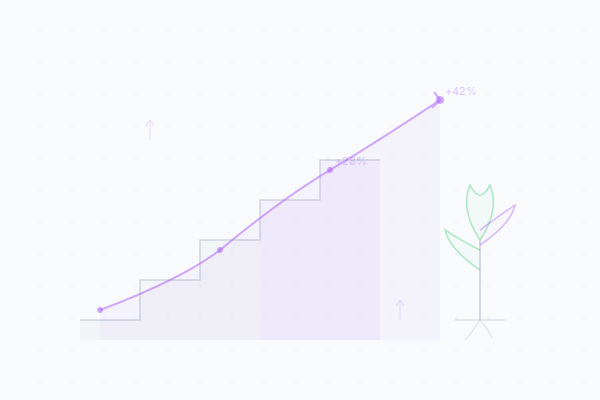

India's regulatory bodies are increasingly adopting single-window clearance systems, reducing approval timelines from months to weeks for compliant applicants.
Digital Approvals and Single-Window Systems: The New Frontier
India has made substantial progress in digitizing its approval infrastructure, driven by the National Single Window System (NSWS) launched by DPIIT (Department for Promotion of Industry and Internal Trade) and complementary state-level platforms. The NSWS aims to be a one-stop digital platform for investors to identify and apply for approvals required from central departments. As of early 2026, the platform covers approvals from over 32 central ministries and departments and has been integrated with the single-window systems of most states. However, digital readiness varies significantly across states. States like Andhra Pradesh (AP INVEST), Telangana (TS-iPASS), Odisha (GO-SWIFT), Gujarat (Investor Facilitation Portal), and Tamil Nadu (TNSWP) have mature single-window systems with deemed approval provisions (where applications not acted upon within specified timelines are automatically approved). Other states lag considerably, with portals that function more as application submission interfaces than true approval platforms. The PM GatiShakti National Master Plan has added a geospatial dimension to infrastructure and industrial project approvals, enabling spatial planning and inter-departmental coordination.
- Begin with the National Single Window System (NSWS) at nsws.gov.in to generate your consolidated approval checklist, known as the 'Know Your Approvals' feature, which identifies applicable central and state approvals based on your industry, activity, and location
- Leverage state single-window deemed approval provisions where available: TS-iPASS in Telangana guarantees approvals within 15 days for large projects, and GO-SWIFT in Odisha provides deemed clearance if authorities fail to respond within the stipulated timeline
- Use the MCA V3 portal for all company law filings including incorporation (SPICe+ form), director KYC (DIR-3 KYC), annual returns (MGT-7), and financial statements (AOC-4), ensuring DSC (Digital Signature Certificate) procurement for all authorized signatories well in advance
- Apply for GST registration through the GST Portal with complete documentation on the first attempt, as incomplete applications trigger deficiency memos that reset the 7-working-day processing timeline and can delay registration by 30 to 45 days
- Monitor the PM GatiShakti portal for infrastructure project approvals and utilize the Unified Logistics Interface Platform (ULIP) for logistics-related permits and clearances, particularly relevant for warehousing, cold chain, and manufacturing operations requiring multi-modal connectivity
States with mature single-window systems have reduced average approval timelines from 92 days to 28 days for new manufacturing investments, according to DPIIT's State Reform Action Plan data. Telangana's TS-iPASS has processed over 18,000 industrial approvals with a 96% deemed approval rate.

India Licensing & Permits Directory
A structured roadmap through India's multi-layered licensing regime covering central registrations, state permits, environmental clearances, labor compliance, and the emerging digital approval infrastructure.