
External Commercial Borrowings: The RBI's Gatekeeping Framework
External Commercial Borrowings (ECBs) remain the primary mechanism through which Indian entities access foreign-currency debt. The regulatory framework, administered by the Reserve Bank of India under FEMA (Foreign Exchange Management Act, 1999) and the ECB Master Direction of January 2019 (updated periodically), creates a dual-track system: the automatic route, under which borrowings that meet prescribed conditions require no prior RBI approval, and the approval route, which requires case-by-case clearance from the RBI's Foreign Exchange Department. Under the automatic route, eligible borrowers (including Indian companies, NBFCs-ND-SI, port trusts, SEZ units, and SIDBI) can raise ECBs up to USD 750 million per financial year from recognised lenders, subject to an all-in cost ceiling pegged to the applicable benchmark rate (currently SOFR for USD borrowings) plus 550 basis points. The minimum average maturity period (MAMP) is 3 years for ECBs up to USD 50 million and 5 years for ECBs above that threshold. End-use restrictions are critical: ECB proceeds cannot be used for investment in real estate, capital markets, or equity investment domestically, and on-lending is restricted to specific categories. Violations of end-use provisions trigger compounding penalties under FEMA Section 13 and can result in debarment from future ECB access.
- The automatic route permits ECBs up to USD 750 million per financial year, subject to an all-in cost ceiling of the benchmark rate (SOFR for USD) plus 550 basis points and minimum average maturity of 3-5 years
- End-use restrictions are strictly enforced — ECB proceeds cannot fund real estate acquisition, capital market investment, or general corporate purposes beyond the prescribed categories without RBI approval
- All ECBs must be reported to the RBI through the ECB-2 Return filed monthly via the FIRMS portal (Foreign Investment Reporting and Management System), with the AD Category I bank as the filing intermediary
- Hedging requirements mandate that ECB borrowers with no natural hedge must cover at least 70 percent of the ECB exposure through financial hedges (forward contracts, options, or swaps) for the residual maturity
- The Liberalised ECB Framework introduced in 2019 expanded the eligible borrower list and rationalised end-use restrictions, but compliance remains granular — engage specialised FEMA counsel before structuring any ECB
FEMA contraventions on ECBs are compoundable offences under Section 15, with penalties up to three times the amount involved. The RBI's Compounding Directorate processed over 1,200 compounding applications in FY2025, the majority involving ECB-related violations.

A comprehensive funding strategy maps capital requirements to the optimal mix of equity, debt, and hybrid instruments available in India.
Domestic Bank Lending: Navigating India's Credit Ecosystem
India's banking system, comprising 12 public sector banks, 21 private sector banks, and 44 foreign bank branches, deployed approximately INR 164 lakh crore in non-food credit as of March 2026 (RBI data). For foreign-owned entities operating in India, accessing this domestic credit pool requires understanding several structural realities. First, Indian banks assess creditworthiness through a combination of CIBIL/CRIF credit scores, financial statement analysis (typically requiring 2-3 years of audited Indian financials), and collateral adequacy — the concept of unsecured corporate lending is far less prevalent than in Western markets, particularly from public sector banks. Second, the interest rate environment is shaped by the RBI's repo rate (currently 6.25 percent as of February 2025 after the 25 bps cut), with effective lending rates for well-rated corporates (AAA/AA) ranging from 8.5 to 10.5 percent and for mid-market companies from 11 to 14 percent. Third, priority sector lending (PSL) norms under RBI's Master Direction require banks to allocate 40 percent of adjusted net bank credit to priority sectors including agriculture, MSMEs, education, and housing — if your India entity qualifies as an MSME under the revised Udyam Registration criteria (investment up to INR 50 crore and turnover up to INR 250 crore for medium enterprises), you gain access to mandated PSL allocations, which often come at preferential rates.
- Indian banks typically require 2-3 years of audited local financials before extending term credit — newly incorporated subsidiaries should plan for parent company guarantees or standby letters of credit to bridge this gap
- Effective lending rates range from 8.5-10.5 percent for AAA/AA-rated corporates to 11-14 percent for mid-market companies, with rates linked to the bank's MCLR (Marginal Cost of Funds Based Lending Rate) or external benchmark (repo rate)
- Udyam Registration as an MSME (investment up to INR 50 crore, turnover up to INR 250 crore) unlocks priority sector lending allocations, CGTMSE collateral-free guarantees up to INR 5 crore, and preferential interest rates
- The Credit Guarantee Fund Trust for Micro and Small Enterprises (CGTMSE) provides collateral-free credit guarantees up to INR 5 crore, eliminating the need for property collateral — a significant advantage for asset-light businesses
- Public sector banks (SBI, Bank of Baroda, Punjab National Bank) offer the most competitive rates but have longer processing timelines; private banks (HDFC Bank, ICICI Bank, Axis Bank) process faster but at a 50-150 bps premium
Apply for Udyam Registration immediately upon incorporating your India entity if you qualify. It is free, completed online in under 30 minutes, and unlocks a cascade of benefits including CGTMSE guarantees, PSL rate access, and delayed payment protection under the MSMED Act.
NBFCs and Alternative Lenders: Speed Over Cost
India's non-banking financial company (NBFC) sector, regulated by the RBI under the revised Scale Based Regulation (SBR) framework introduced in October 2022, has emerged as a critical funding source for segments underserved by traditional banks. The approximately 9,400 registered NBFCs (of which around 400 are systemically important with asset size above INR 500 crore) fill gaps in speed, flexibility, and risk appetite that the banking system cannot or will not address. For foreign entrants, NBFCs offer several advantages: faster credit decisioning (7-15 days versus 30-60 days for banks), willingness to lend against non-traditional collateral (receivables, inventory, intellectual property), and more flexible structuring of repayment schedules. The trade-off is cost — NBFC lending rates typically run 200 to 500 basis points above bank rates, with effective rates of 14 to 22 percent depending on the borrower's profile and the facility type. Revenue-based financing, a model pioneered in India by firms like Recur Club, GetVantage, and Velocity, offers non-dilutive capital linked to monthly revenue performance — particularly relevant for SaaS and D2C businesses with predictable recurring revenues. Invoice discounting platforms registered with the TReDS (Trade Receivables Discounting System) framework — platforms like M1xchange, RXIL, and Invoicemart — enable MSME suppliers to discount invoices from large buyers at competitive rates, providing working capital without creating additional debt on the balance sheet.
- NBFCs process credit applications in 7-15 days versus 30-60 days for banks, making them the preferred option when speed of capital deployment is critical to capturing a market window
- Lending rates from NBFCs range from 14 to 22 percent, representing a 200-500 bps premium over bank rates — model this cost differential against the revenue impact of faster deployment when making funding source decisions
- Revenue-based financing from platforms like Recur Club and GetVantage provides non-dilutive capital at 12-18 percent flat cost, repaid as a fixed percentage of monthly revenue — suited for SaaS and D2C businesses with MRR above INR 10 lakh
- TReDS platforms (M1xchange, RXIL, Invoicemart) enable invoice discounting at 8-11 percent for invoices from rated buyers, providing working capital without creating traditional debt — all CPSE and companies with turnover above INR 500 crore are mandated to onboard TReDS
- The RBI's Scale Based Regulation framework classifies NBFCs into four layers (Base, Middle, Upper, Top) with progressively stricter prudential norms — borrow from Upper Layer NBFCs for better counterparty stability and regulatory oversight
NBFC credit to the commercial sector grew 16.2 percent year-over-year in FY2025, outpacing bank credit growth of 12.4 percent. NBFCs now account for approximately 25 percent of total institutional credit in India.
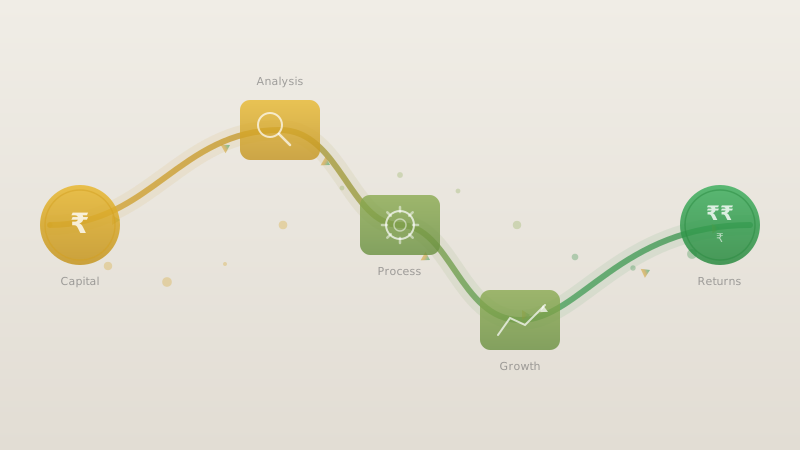
India's FEMA framework governs all cross-border capital flows, requiring careful structuring of each funding tranche to ensure regulatory compliance.
India Business Funding Handbook
A comprehensive reference for structuring debt, equity, and hybrid funding for India operations — covering RBI regulations, domestic and alternative lending, government incentive schemes, and working capital optimisation.
Government Incentive Schemes: PLI, Startup India, and Beyond
The Indian government operates one of the most extensive industrial incentive architectures in the developing world, and yet many foreign firms either fail to access these schemes or leave significant value on the table through incomplete applications. The Production Linked Incentive (PLI) scheme, launched in 2020 and expanded across 14 sectors with a total outlay of INR 1.97 lakh crore (approximately USD 24 billion), provides direct fiscal incentives calculated as a percentage of incremental sales over a base year — ranging from 4 to 6 percent for electronics manufacturing to 8 to 18 percent for pharmaceutical APIs and key starting materials. PLI is not a subsidy in the traditional sense; it is a performance-linked cashback that rewards actual production and sales growth, making it genuinely attractive for firms with credible manufacturing plans. Startup India, administered by DPIIT, provides eligible startups (entities incorporated as a private limited company, LLP, or partnership firm, less than 10 years old, with turnover below INR 100 crore in any financial year) with a three-year tax holiday under Section 80-IAC of the Income Tax Act, exemption from angel tax provisions under Section 56(2)(viib), self-certification for six labour laws and three environmental laws, and access to the Fund of Funds for Startups (FFS) managed by SIDBI with a corpus of INR 10,000 crore. State-level incentives add another layer: most states operate their own industrial policies offering capital subsidies (15-35 percent of fixed capital investment), stamp duty exemptions, electricity duty waivers, and employment-linked incentives.
- PLI incentives across 14 sectors range from 4-18 percent of incremental sales over a 4-6 year horizon — the electronics, pharmaceutical, and automotive sectors offer the most substantial per-unit incentives for manufacturing operations
- Startup India recognition under DPIIT provides a 3-year tax holiday (Section 80-IAC), angel tax exemption (Section 56(2)(viib)), and access to the INR 10,000 crore Fund of Funds for Startups via SIDBI
- State industrial policies offer capital subsidies of 15-35 percent on fixed capital investment — Tamil Nadu, Karnataka, Telangana, Gujarat, and Maharashtra have the most competitive packages for manufacturing and IT/ITeS operations
- The ECLGS (Emergency Credit Line Guarantee Scheme), originally launched during COVID, has been extended in modified form as the Credit Guarantee Scheme for MSMEs, providing government-backed guarantees that lower effective borrowing costs by 150-200 bps
- Apply for multiple non-competing schemes simultaneously — a single manufacturing operation in the right state can stack PLI incentives, state capital subsidies, CGTMSE loan guarantees, and SEZ duty exemptions to reduce effective capital outlay by 30-45 percent
Engage a specialised government liaison firm (not just a CA or law firm) to navigate PLI and state scheme applications. The approval process involves multiple ministries, detailed production projections, and milestone-based disbursements that require dedicated compliance management.

Robust financial modeling accounts for INR volatility, withholding tax implications, and repatriation timelines when planning India funding rounds.
Working Capital: The Silent Killer of India Operations
More foreign-backed India operations fail due to working capital mismanagement than due to weak demand. The structural realities of Indian trade create a cash conversion cycle that is typically 30 to 60 days longer than what firms experience in developed markets. Payment terms in general trade distribution are 21 to 45 days, with enforcement that is culturally fraught — aggressive collection practices damage the distributor relationship that you spent months building. GST input tax credit (ITC) delays compound the problem: while the GST framework envisions seamless credit flow, in practice, ITC claims are frequently blocked due to vendor non-compliance (failure to file GSTR-1 or GSTR-3B), mismatches between GSTR-2A auto-populated data and actual invoices, or departmental audits triggered by anomaly detection algorithms. A single non-compliant vendor in your supply chain can result in ITC reversals that directly impact your working capital. The MSMED Act, 2006 (as amended) mandates that buyers pay MSME suppliers within 45 days of acceptance of goods or services, failing which interest at three times the bank rate is payable — but enforcement is uneven and most MSMEs are reluctant to invoke this provision against large buyers for fear of losing the relationship. Proactive working capital management in India requires three elements: stringent vendor GST compliance monitoring (automate GSTIN validation and return filing checks), dynamic credit limit management for distributors (linked to actual secondary sales, not primary billing), and a systematic cash flow forecasting model that accounts for India's 60-day festival and quarter-end payment seasonality.
- India's typical cash conversion cycle for B2B operations runs 90-120 days versus 45-60 days in developed markets — model your India working capital requirement at 2-2.5x the level you would allocate for a comparable Western operation
- GST ITC blocking is the most underestimated working capital risk: a single non-compliant vendor can trigger ITC reversals that create immediate cash outflows — implement automated GSTIN validation and GSTR-1 filing monitoring for all suppliers
- Distributor credit management must be linked to secondary sales (sell-out), not primary billing (sell-in) — extending credit based on primary orders alone inflates channel inventory and creates bad debt exposure when demand softens
- The MSMED Act mandates 45-day payment to MSME suppliers with penalty interest at 3x bank rate for delays, but enforcement is weak — structure your payables to comply voluntarily, as the government is strengthening the MSME Samadhaan portal for online dispute filing
- Build a 13-week rolling cash flow forecast calibrated to India's payment seasonality: collections spike in March (financial year-end), September (H1 close), and during Diwali, while Q1 (April-June) is typically the tightest quarter
GST ITC mismatches resulted in over INR 14,000 crore in blocked credits across Indian businesses in FY2025 (GSTN data). Implement real-time vendor compliance monitoring — do not wait for your quarterly return to discover that a key supplier has not filed.

India Business Funding Handbook
A comprehensive reference for structuring debt, equity, and hybrid funding for India operations — covering RBI regulations, domestic and alternative lending, government incentive schemes, and working capital optimisation.